Psalm 141:2a (WEB)
Let my prayer be set before you like incense…
Where I grew up in New Jersey, it was not uncommon to see the lights of Hanukkah Menorahs on public display during the winter holidays. This Jewish holiday celebrates the restoration and rededication of the Temple by the Maccabees after the Greek ruler Antiochus Epiphanes desecrated the Temple and forbade the worship of Yahweh.
So when the gospel of Luke opens with a scene of Jewish worship and prayer at the Temple in Jerusalem, it is a testimony, in part, to the brave Jewish followers of God who were faithful during times of extreme trial and hardship. Here in the Temple we find the priest Zacharias and the people praying and worshiping Yahweh.
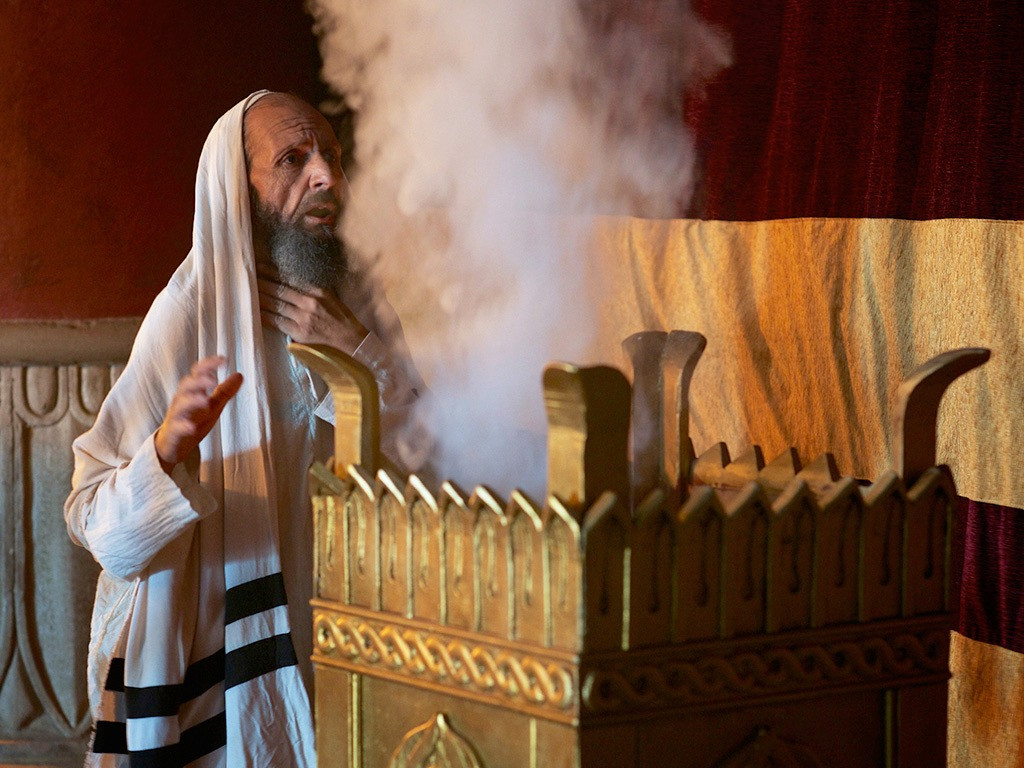
Now while he executed the priest’s office before God in the order of his division according to the custom of the priest’s office, his lot was to enter into the temple of the Lord and burn incense. The whole multitude of the people were praying outside at the hour of incense. (Luke 1:8-10 WEB)
This was a wonderful honor for Zacharias! Because of the great number of priests in Israel, if one was blessed enough to be chosen to offer incense on the altar of God, it would be a once in a lifetime event.
The altar of incense was inside the Temple and directly in front of the curtain that separated the Most Holy Place from the main room of the Temple. The Most Holy Place, also known as the Holy of Holies, was where the Israelites believed the presence of God would meet with them. (Exodus 15:21-22) Only once a year was the high priest allowed to go behind the curtain into the Most Holy Place on the Day of Atonement to make atonement for the nation of Israel. However, twice a day when incense was placed on the altar in front of the curtain, its smoke would rise over the curtain and enter the Most Holy Place. Scripture says it represented the prayers of the people rising to God. (Revelation 5:8)
So it is not surprising that while Zacharias is offering the incense on the altar, the people in the courtyard of the Temple are praying. They were praying a set of prayers called the Amidah. Comprised of 19 blessings and petitions, these prayers were written by leading Israelites like Daniel, Ezra, and Nehemiah around the time of the Babylonian exile. Prayed three times a day, these prayers had been recited thousands of times by the time Zacharias was offering incense in the Temple.
So what were the people actually saying in their prayers? Let’s look at an English translation of a few of these blessings.
Blessing 14, Rebuilding of Jerusalem
Return in compassion to Your city, Jerusalem, and rest within it as You have said. Rebuild it speedily, and in our days, a structure forever. And may You establish the throne of David within Jerusalem speedily. Blessed are You, Lord, the Builder of Jerusalem.
Blessing 15, The Kingdom of David
May the Branch [offspring] of David Thy servant flourish speedily and may his horn be exalted in Your salvation. For in your salvation do we hope all the day. Blessed are You, Lord, Who produces the Horn of Salvation.
Blessing 17, Worship
Accept Your people, O Lord our God, and receive their prayer. Restore the most holy service of Your house and accept in love the offerings and prayers of Israel. May it please You always to want to accept the service of Your people Israel. May our eyes see You return to Zion in mercy. Blessed are You, O Lord, Who restores His Presence to Zion.
So, keep this in mind while we read what happens next in our story in Luke.
An angel of the Lord appeared to him, standing on the right side of the altar of incense. Zacharias was troubled when he saw him, and fear fell upon him. But the angel said to him, “Don’t be afraid, Zacharias, because your request has been heard. Your wife, Elizabeth, will bear you a son, and you shall call his name John. You will have joy and gladness, and many will rejoice at his birth. For he will be great in the sight of the Lord, and he will drink no wine nor strong drink. He will be filled with the Holy Spirit, even from his mother’s womb. He will turn many of the children of Israel to the Lord their God. He will go before him in the spirit and power of Elijah, ‘to turn the hearts of the fathers to the children,’ and the disobedient to the wisdom of the just; to prepare a people prepared for the Lord.” (Luke 1:11-17 WEB)
The angel tells Zacharias that his prayer has been heard and will be answered. In part, this may have included a prayer for his wife, Elizabeth, to have a child. But I believe the angel was also referring to the prayers that the people and Zacharias were praying right then. Consider this. They were praying, “May the Offspring of David Your servant flourish speedily,” and, “Return in compassion to Your city, Jerusalem, and rest within it,” and, ‘May our eyes see You return to Zion in mercy.”
It’s like the angel tells Zacharias, “All right! Now’s the time! The Offspring of David is coming now! And, since you also prayed, ‘May it please You always to want to accept the service of Your people Israel,’ here’s the way you can serve God right now. You can be a part of God’s plan. Your wife, Elizabeth will give birth to the one who goes before the Messiah, preparing the hearts of the people to receive His message.”
When God determined it was time to send the Messiah, He did answer speedily! So many prayers are being answered here. And isn’t it amazing when God answers our prayers by making us the answer to that prayer? I think that is because God puts it on our hearts to pray for certain things. And as we pray about it, we too become concerned about it. And then we are willing to obey when He opens the door for us to participate in His answer to that prayer.
So, whether it is the Israelites living during the time of the Maccabean Revolt, or whether it is Zacharias and Elizabeth, or even you and I, God often uses our service as the answer to our prayers.
And did you see that the angel also said Zacharias and Elizabeth would be blessed with joy and gladness? This is their reward for persevering in prayer and serving God. And they will be so happy to serve God in this way, won’t they?
Chris Tomloin, “O Come, O Come Emmanuel”
Source material for this lesson was taken from Hebrew4Christians.com, “Weekday Amidah,” https://hebrew4christians.com/Prayers/Daily_Prayers/Shemoneh_Esrei/H4C-weekday-amidah.pdf
Scripture verses are from the World English Bible (WEB), Public Domain.