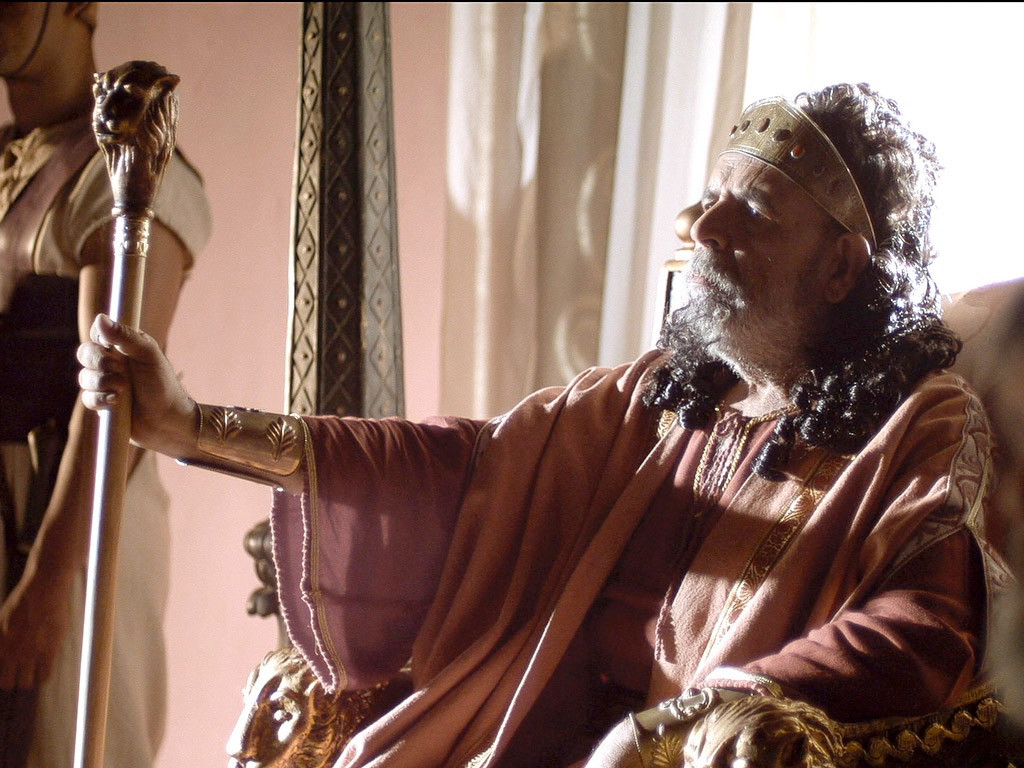
Today, we pick up again the story of the wise men in Matthew 2:1-3.
Now when Jesus was born in Bethlehem of Judea in the days of King Herod, behold, wise men from the east came to Jerusalem, saying, “Where is he who is born King of the Jews? For we saw his star in the east, and have come to worship him.” When King Herod heard it, he was troubled, and all Jerusalem with him.
Matthew 2:1-3 (WEB)
If you are not familiar with this story, you may wonder why Herod was “troubled” by the wise men’s news. We shall find out that this king is ruthless and paranoid, and when he feels threatened, people die. So the people of Jerusalem are “troubled,” too.
Who was this king, Herod the Great? Well, his kingdom was by Roman appointment. He himself had no claim to any throne. He was neither Jewish nor of royal descent. He was an Edomite, a descendant of Esau, from a wealthy and powerful family that had been supportive of the Roman Empire. When the Romans brought the Jewish Hasmonean dynasty to an end with much bloodshed, Herod’s father and family were rewarded with positions of authority and governance. This did not endear them to the Jewish population. Neither did their collection of Rome’s taxes. Herod’s life had been in danger many times. Yet somehow, even as Rome continued to roil with internal struggles for dominance within her own leadership, Herod managed to stay alive and maintain his position by shrewd political moves and alliances.
He is remembered mostly for two reasons. One was his architectural accomplishments. He was determined to transform his kingdom into a more modern and cultured civilization reflecting Greek and Roman standards. So he built amphitheaters, palaces, and fortresses. But perhaps the most notable of his projects was the renovation of the Temple in Jerusalem. Made of huge, white marble stones and covered in gold, it brilliantly reflected the sunlight as it sat high upon its mountainous base. Its beauty was something to behold!
The second thing he was known for was his incredible cruelty. He was always suspicious that someone was going to overthrow him. And when he thought someone might be trying to take his throne, he had them killed, relative or not. He even killed some of his own sons and at least one wife! The people he ruled feared him.
So the wise men could not have brought their announcement of a newborn king to a worse place. The last thing Herod wanted to hear was the possibility of another claim to the Jewish throne. But he is cunning and has learned how to survive all intrigues, real and imagined. Feigning supportive interest, he calls together the Jewish rabbis familiar with the Israelites’ ancient prophecies.
Gathering together all the chief priests and scribes of the people, he asked them where the Christ would be born. They said to him, “In Bethlehem of Judea, for this is written through the prophet,
‘You Bethlehem, land of Judah, are in no way least among the princes of Judah; for out of you shall come a governor who shall shepherd my people, Israel.’”Then Herod secretly called the wise men, and learned from them exactly what time the star appeared. He sent them to Bethlehem, and said, “Go and search diligently for the young child. When you have found him, bring me word, so that I also may come and worship him.”
Matthew 2:4-8 (WEB)
It is obvious that Herod knew who the religious leaders were talking about, for he himself calls him “the Christ”, which is Greek for the Messiah. And though he says he wants to “worship” the Messiah, we shall learn later that this is clearly not his intent. He shares authority with no one. And he protects his throne at all costs, even if that means killing the Messiah!
The difference between these two kings is striking. Herod has no real claim to royalty at all. He himself is subject to Rome. Yet he is desperate to hold on to whatever power and prestige he can get, and kills all who stand in his way. His attention is focused on outward appearances. He pours himself into building projects and culture that portray a strong kingdom. Though outwardly religious, he is evil to the core. He is supremely selfish. And He rules his people by fear.
Jesus, a far greater king, is the embodiment of unselfishness and love. He lays aside his heavenly luxury to live a common life so He can redeem His people from their sin. Instead of killing, He gives his own life. He loves His people and shepherds them with kindness. He came to serve, not to be served.
Have this in your mind, which was also in Christ Jesus, who, existing in the form of God, didn’t consider equality with God a thing to be grasped, but emptied himself, taking the form of a servant, being made in the likeness of men. And being found in human form, he humbled himself, becoming obedient to the point of death, yes, the death of the cross.
Philippians 2:5-8 (WEB)
We have a choice to make every day. We can choose to live a life of selfishness and greed, like Herod. We may gain some pretty impressive earthly rewards. But we may also destroy ourselves and those around us by our own selfishness.
Or we can choose the way of Christ. We can choose a different kind of strength. The strength that comes from unselfish service, humility, and love. These things will not destroy us or those around us. And the rewards are heavenly.
For it is God who works in you both to will and to work for his good pleasure.
Do all things without complaining and arguing, that you may become blameless and harmless, children of God without defect in the middle of a crooked and perverse generation, among whom you are seen as lights in the world, holding up the word of life…Philippians 2:13-16a (WEB)
“One Small Child,” composed by David Meece and Justin Unger, performed by Justin Unger with Falon Unger.
Scripture Verses are from the World English Bible (WEB), Public Domain.