Revelation 21:4(KJV)
And God shall wipe away all tears from their eyes; and there shall be no more death, neither sorrow, nor crying, neither shall there be any more pain: for the former things are passed away.
We have now come to the most agonizing part of the Christmas story. For now a curtain is drawn back and the battle between good and evil is starkly revealed.
Then Herod, when he saw that he was mocked by the wise men, was exceedingly angry, and sent out and killed all the male children who were in Bethlehem and in all the surrounding countryside, from two years old and under, according to the exact time which he had learned from the wise men. Then that which was spoken by Jeremiah the prophet was fulfilled, saying,
“A voice was heard in Ramah, lamentation, weeping and great mourning, Rachel weeping for her children; she wouldn’t be comforted, because they are no more.”
Matthew 2:16-18(WEB)
There is a kind of raw evil in this world that we find hard to comprehend. It usually leads us to question, “How can anyone do such an evil thing? And how can God allow this?” All of us have contemplated these questions at some time. And though there is much that could be said about this, the passage Matthew quotes from in Jeremiah has some very helpful words to think about.
To begin with, how did evil enter our world? We have talked about the Fall of Man (December 4, “Fall of Man”). We have also talked about how God gave humans dominion over this earth and all its creation. (December 3, “Dominion”) So when we make choices, whether for good or evil, those decisions affect not only us, but also those around us.
Many times we blame God for the evil that is in our world. But in reality, those evil things are mostly the result of mankind’s decisions to choose evil. And Herod was not the only one who chose to do evil in this story. Others, like the soldiers, made a decision to follow evil orders.
We were created to do good and seek justice, but mankind’s propensity to choose selfishness and evil is like a chain that holds us captive to our own desires. So the only way to fix our world is through healing our hearts from its bent towards sin.
The passage quoted from Jeremiah speaks directly to this. It is written as poetry, which means it uses metaphors and it can also have layers of meaning. First, it is describing an actual event during Jeremiah’s time. When the Babylonians captured Jerusalem, the inhabitants of Jerusalem were taken north to the town of Ramah. (Jeremiah 40:1) There the people, in chains, were brought before the ruler who decided each person’s fate: who would die, who would remain in chains and be taken away to Babylon, and who would be freed and stay in Israel. Rachel is used as a metaphor in this passage, representing the mothers of Israel mourning the loss of their children through death and captivity.
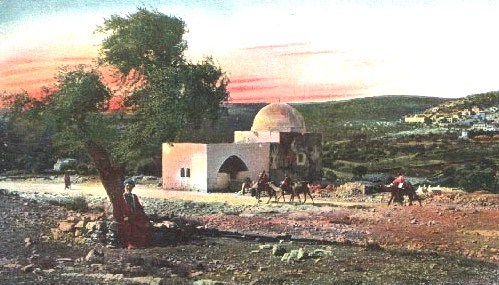
Matthew, the gospel author, compares the despair of that moment to what happened centuries later in Bethlehem. However, in this case, the name Ramah is not used to refer to the town located north of Jerusalem. Instead, the definition of the word Ramah, which means “a high hill,” is important. For it was near Bethlehem, on a high hill, that Rachel, Jacob’s wife, was buried. This was a place of great significance to the people of Israel. Rachel died in childbirth. And as she was dying, she named her son Ben Oni, “son of my sorrow”. (Genesis 35:18) In Matthew’s quotation, Rachel, the sorrowing mother, represents the mothers of Bethlehem grieving over their murdered sons.
Yet, if we read the rest of Jeremiah’s prophecy, we find words of comfort.
Yahweh says:
“Refrain your voice from weeping, and your eyes from tears, for your work will be rewarded,” says Yahweh. “They will come again from the land of the enemy. There is hope for your latter end,” says Yahweh. “Your children will come again to their own territory.”Jeremiah 31:16-17(WEB)
This did indeed happen, in reality, decades later, when the Babylonian exiles returned to Israel. But Jeremiah’s gaze perhaps searches much farther in the future, when a few verses later we read the following.
…For Yahweh has created a new thing in the earth:
a woman will encompass a man.”Jeremiah 31:22b(WEB)
Some suggest the phrase “a woman will encompass a man” refers to a woman pregnant with a male child, namely, the Messiah. And in Matthew’s passage, we see the Messiah, as a baby, being sent right into the midst of the chaos and turmoil of humanity. The timing of his coming merely showcases the reason or need for his coming. He came to make a way for salvation, to change hearts, and to bring hope of a future justice and restoration.
Rachel’s husband changed the name of their baby from Ben-Oni, son of my sorrow, to Benjamin, son of my right hand, meaning, son of my strength. (Exodus 15:6) So too, God sent his son, the Messiah, in the strength of his right arm, to accomplish what no other human could do. Though known as a man of sorrows and acquainted with grief, it was through Jesus’ sufferings on the cross that He provided the way of salvation. (Isaiah 53:3-5) This salvation could release us from the chains of sin and give us a new heart that would follow righteousness.
“But this is the covenant that I will make with the house of Israel after those days,” says Yahweh:
“I will put my law in their inward parts, and I will write it in their heart. I will be their God, and they shall be my people. They will no longer each teach his neighbor, and every man teach his brother, saying, ‘Know Yahweh;’ for they will all know me, from their least to their greatest,” says Yahweh, “for I will forgive their iniquity, and I will remember their sin no more.”Jeremiah 31:33-34(WEB)
God did not turn his eyes away from the destruction of Bethlehem’s babies. Jesus stayed alive so he could grow up to pay for those sins committed in Bethlehem. Justice was met on Him when He died on the cross. If any of those soldiers who killed those babies repented and asked God to forgive them and said, “God, please, account Jesus’ death as payment for my sins,” God would be merciful to a truly repentant heart. And His goal would be to change their hearts through the power of the Holy Spirit. For those who did not repent, they will face God at the final judgement, when all will stand before God.
For those who have faced unimaginable evil in their lives, know that Jesus has not run away from you. He has not abandoned you. No, He is intimately acquainted with your grief and your sorrow, for He bore it on the cross. Cast your sorrow and your grief on Him. He will bear it. He will sustain you. He will comfort you with His love.
There is hope and restoration in Jesus. Not only does God promise that He is a righteous and true judge, but God also says that “There is hope in your latter end.” (Jeremiah 31:17) There is a future of hope ahead of you. For God is the God who can bring healing. He can satisfy your soul and bring you comfort. Because He bears the scars of the cross, our scars can be healed.
Jeremiah 31:25(WEB)
“For I have satiated the weary soul, and I have replenished every sorrowful soul.”
He is despised and rejected of men; a man of sorrows, and acquainted with grief: and we hid as it were our faces from him; he was despised, and we esteemed him not.
Surely he hath borne our griefs, and carried our sorrows: yet we did esteem him stricken, smitten of God, and afflicted.
But he was wounded for our transgressions, he was bruised for our iniquities: the chastisement of our peace was upon him; and with his stripes we are healed.
Isaiah 53:3-5 (KJV)
“Every Tear,” by Matthew West
Scripture verses were taken from the World English Bible (WEB) and the King James Version (KJV), Public Domain.