O little town of Bethlehem,
how still we see thee lie!
Above thy deep and dreamless sleep
the silent stars go by.
Yet in thy dark streets shineth
the everlasting light;
the hopes and fears of all the years
are met in thee tonight.
A December without Christmas carols would be like the Fourth of July without fireworks. Love ‘em or hate ‘em, they are a tradition that has been a part of American Christmas celebrations for years. Each generation has their own favorites. But some songs pass the test of time, becoming treasured classics. O Little Town of Bethlehem is one such song.
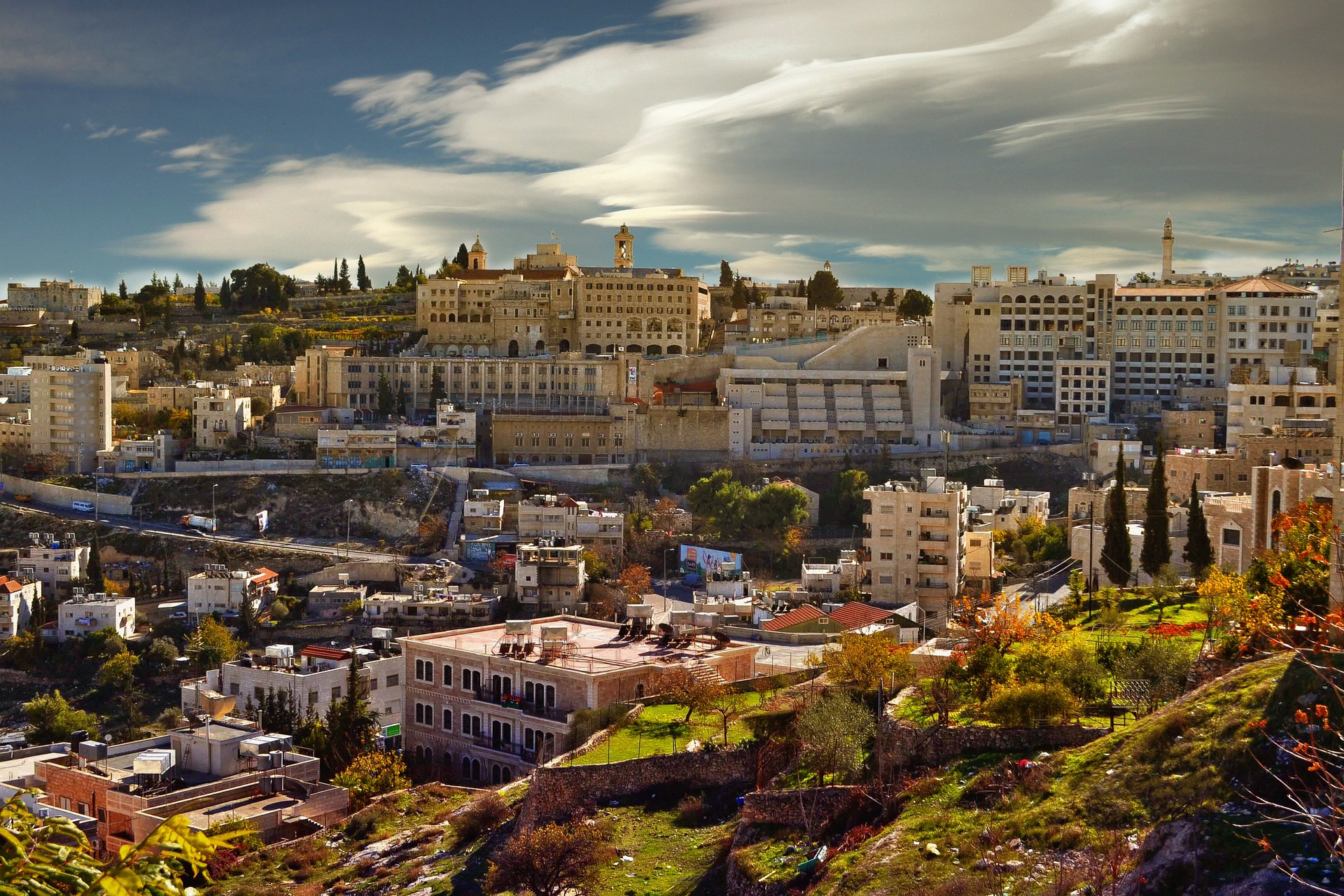
Most of us are familiar with the words to this song with its gentle and peaceful setting. When Rev. Phillips Brooks penned the words to his familiar Christmas carol in 1865, Bethlehem was still a “little town.” How times have changed! Today, Bethlehem boast a population of almost 30,000 people. Under the control of the Palestinian Authority, Bethlehem lies within the West Bank, about 6 miles south of Jerusalem. The majority of its residents are Muslim, while a dwindling Arab Christian remnant remains.
But many years ago, when a prophet named Micah wrote about Bethlehem, it was just a little Jewish town.
But you, Bethlehem Ephrathah,
being small among the clans of Judah,
out of you one will come out to me who is to be ruler in Israel;
whose goings out are from of old, from ancient times. (Micah 5:2 WEB)
To Micah’s Jewish listeners, the town of Bethlehem, though small, was full of historical context. For Bethlehem was already known as the birthplace of some other famous Jewish babies.
It was in Bethlehem that their most revered king had been born, King David. And though shepherds and Bethlehem are forever linked together in our modern Christmas story, this was nothing new. For David himself became famous as the shepherd boy of Bethlehem who killed the giant, Goliath.
Micah’s Jewish listeners would also remember Bethlehem as the scene of their beloved story of Ruth and Boaz. The name Bethlehem means “House of Bread’ or “House of Food.” And the love story of Ruth and Boaz unfolds during the time of the barley and wheat harvests. Here, the impoverished young widow, Ruth, finds provision and hope. And through her marriage to Boaz, a family line is redeemed and restored, bringing back to life that which was dead. Their baby, Obed, becomes the great-grandfather of David.
Yet, prior to these happy stories, there was one story of a baby’s birth near Bethlehem that was quite sad. For it was here that Jacob’s wife, Rachel, also gave birth to a son. She had longed for this child for many years. But when his birth came, her labor was extremely difficult. And as she was dying, she gave him a name that echoes with the pain of Eve. She named him, Ben-Oni, meaning “son of my sorrow.” (Genesis 35:18) But her husband Jacob, though struggling with his own grief over the loss of his wife, looked down at his new born son and gave him a name of blessing and strength. He named him Benjamin, “son of my right hand.” And as such he was known.
In an amazing way, the stories of all these babies born in Bethlehem resonate with meaning for the birth of Mary’s baby boy, Jesus. For he was born to remove the sorrow of death and to redeem humanity from the heaviness of sin. He, who was born in the “House of Bread,” called himself the Bread of Life. And though he was the King of Kings, he was placed in a shepherd’s humble manger at birth. On this earth he was “a man of sorrows and acquainted with grief,” (Isaiah 53:3). Yet now He has risen and is seated at the right hand of God. (Mark 16:19, Romans 8:34)
Each of us have our own birth story, as well as a back-story. And whether it is full of joy or sorrow, prosperity or poverty, you are known to the God of Creation. You are precious to him and held in his hands.
John 6:51(KJV)
I am the living bread which came down from heaven: if any man eat of this bread, he shall live for ever: and the bread that I will give is my flesh, which I will give for the life of the world.
“O Little Town of Bethlehem,” sung by Nat King Cole
Scripture verses taken from the King James Version (KJV) and the World English Bible (WEB), which are in the Public Domain.